SMMT – Vehicle manufacturing falls despite EV revolution and significant market pressure
4 min read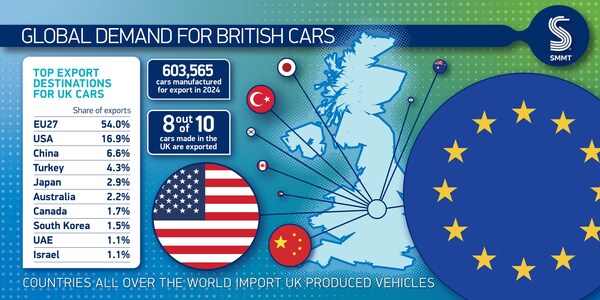
Top UK Car Exports 2024
Asian Aussie Business | According to the latest data released today by the Society of Motor Manufacturers and Traders (SMMT), UK car production will fall below one million units by 2024. Factories produced 779,584 automobiles and 125,649 commercial vehicles (CVs), for a total of 905,233 units, -11.8% less than in 2023. While CV output increased by 4.0%, the highest level since 2008, several factors hampered car volumes, including the discontinuation of production for some long-running models as factories retooled for EVs, downturn in major global markets, and a slowing in the shift to electrification amid tough economic conditions.
Following a flurry of restructuring announcements across the UK and Europe, reflecting the problems of transitioning from ICE to EV production, British car production fell -27.1% in December to 45,022 units, bringing the total to ten consecutive months of decrease. Over the year, car production plummeted -13.9%, with output for the UK market falling -8.0% to 176,019 units, while exports fell -15.5% to 603,565 vehicles.
Last year, over eight out of every ten automobiles produced were exported, with 77.5% (467,937 units) going to the top three markets: the EU (54.0%), the United States (16.9%), and China (6.6%). Exports to the EU and China fell -24.3% and -21.8%, respectively, but exports to the United States increased 38.5%, highlighting the importance of supporting trading circumstances across the Atlantic. Turkey and Japan rounded out the UK’s top five worldwide export markets, followed by Australia, Canada, South Korea, the UAE, and Israel.
Given the total transition happening at many car facilities, a decrease in battery electric (BEV), plug-in hybrid (PHEV), and hybrid (HEV) vehicle output was anticipated. Volumes of these electrified technologies declined to 275,896 units, down 20.4% from the previous year, although they still amounted for 35.4% of total output, the second most on record. With over £20 billion in investment announced in 2023 and an additional £3.5 billion in 2024 to drive the UK’s transition to EV manufacture, the fall will be temporary.1
Mike Hawes, SMMT Chief Executive, stated, “Amid major geopolitical and trade concerns, UK manufacturers are determined to turn billions of pounds of investment into production realities, transforming factories to produce new electric vehicles for sale across the world. Growing pains are unavoidable, thus last year’s reduction in volumes is not unexpected. With new, innovative models and battery production on the horizon, the opportunity for expansion is obvious. Securing this future, however, necessitates industrial and trade strategies that provide the competitive circumstances needed for growth in an increasingly protectionist global market.”
According to the most recent independent production projection, UK car and light van production will be around 839,000 units in 2025, rising to 930,000 units in 2027, with the potential to exceed one million units in 2028 and more than 1.1 million by 2030.2 This, however, is predicated on strengthening global car and van market demand, positive economic conditions, and increased consumer confidence, as well as the delivery of the competitive conditions required to ensure zero-emission model launches remain on track.
To realise this objective and unlock future growth, an industrial strategy centered on sophisticated automobile manufacturing would be required, enabling innovation, attracting investment, and supporting the country’s highly educated workforce. Equally vital is a solid domestic market, given that manufacturers construct close to where they sell, as well as strong international demand, particularly for electrified vehicles, which the industry and government have invested billions of dollars to developing.
As a result, the sector need market regulation that reflects the realities of natural demand, as well as a fiscal framework that encourages customers to purchase these new cars, which are critical to achieving our shared net zero aspirations. This must be consistent with an ambitious trade policy that includes a tariff-free enhanced trade partnership with the EU, as well as balanced, economically meaningful trade agreements and crucial minerals agreements with both existing and new trading partners.
The proper policies will assist safeguard the sector’s position as a £100 billion global trading hub, with the potential to generate £50 billion in UK growth over the next decade, thereby supporting the government’s economic, sociological, and environmental goals.3
Notes to Editors
1: The SMMT projections are based on publicly declared public and private investment pledges in UK automotive production and R&D till 2024.
2: Based on an independent production projection issued by AutoAnalysis in November for cars and light vans.
3: SMMT Trade Snapshot 2024, SMMT Vision 2035.
About the SMMT and the UK automobile industry.
The Society of Motor Manufacturers and Traders (SMMT) is a significant and prominent trade body that represents the UK automotive sector. The automobile industry is an important part of the UK economy, contributing to growth, achieving net zero, and positioning the UK as a worldwide trade hub. It generates £93 billion in revenue and £22 billion in value contributed to the UK economy, and invests approximately £4 billion each year in R&D. Manufacturing employs 198,000 people directly, while the automobile industry employs over 813,000 people in total.
The United Kingdom manufactures practically every form of vehicle, including cars, vans, taxis, lorries, buses, and coaches, as well as specialist and off-highway vehicles, with the help of over 2,500 component suppliers and some of the world’s most qualified engineers. In addition, the sector features a thriving aftermarket and remanufacturing sectors. The automobile industry also provides jobs in other important areas such as advertising, chemicals, finance, logistics, and steel.
SMMT’s publication: Motor Industry Facts www.smmt.co.uk/reports/smmt-motor-industry-facts/
UK VEHICLE MANUFACTURING (statistics from December and FY 2024)
High-resolution charts are accessible via Dropbox: https://www.dropbox.com/scl/fo/a1iat513l4t5r3rkdb57o/AJw7kC6rKE9DvMm6-E_Amlo?rlkey=cy9q0ydz6sbov67itj36ki4v0&st=adloem9m&dl=0
Source: Society of Motor Manufacturers and Traders Limited (SMMT).